Headache & neurology support · Patient guide
You can't change your wiring — but you can lower your day-to-day risk
Migraine is a genetic, neurological condition. You can't change the underlying biology, but small, consistent daily habits can stabilize your nervous system, raise your "migraine threshold," and reduce how often and how hard attacks strike.
How to use this page
This page covers general lifestyle strategies for people living with migraine. It isn't a treatment plan and doesn't replace evaluation by your physician or neurologist — especially if your headaches are changing in pattern, frequency, or severity. If you're having a severe attack right now, see our IV migraine cocktail therapy page, our overview of migraine infusion therapy, or contact your care team.
Migraines aren't random — think in terms of a threshold
Attacks can feel like they come out of nowhere, but most people are living with a genetic threshold for headache that stays relatively fixed — while day-to-day factors (sleep, stress, meals, hydration, hormones, weather, screens) raise or lower how close you are to crossing it.
The goal of management isn't to eliminate every possible trigger — that's rarely realistic. It's to stabilize your baseline so ordinary daily stress doesn't push you over the edge as often. When your brain's baseline is steadier, the same amount of strain is less likely to cross the line and set off an attack. That's the idea behind the strategies below.
The SEEDS framework
A widely used framework from headache medicine organizes lifestyle management into five areas: Sleep, Exercise, Eat, Diary, and Stress. Each targets a common source of cumulative strain.
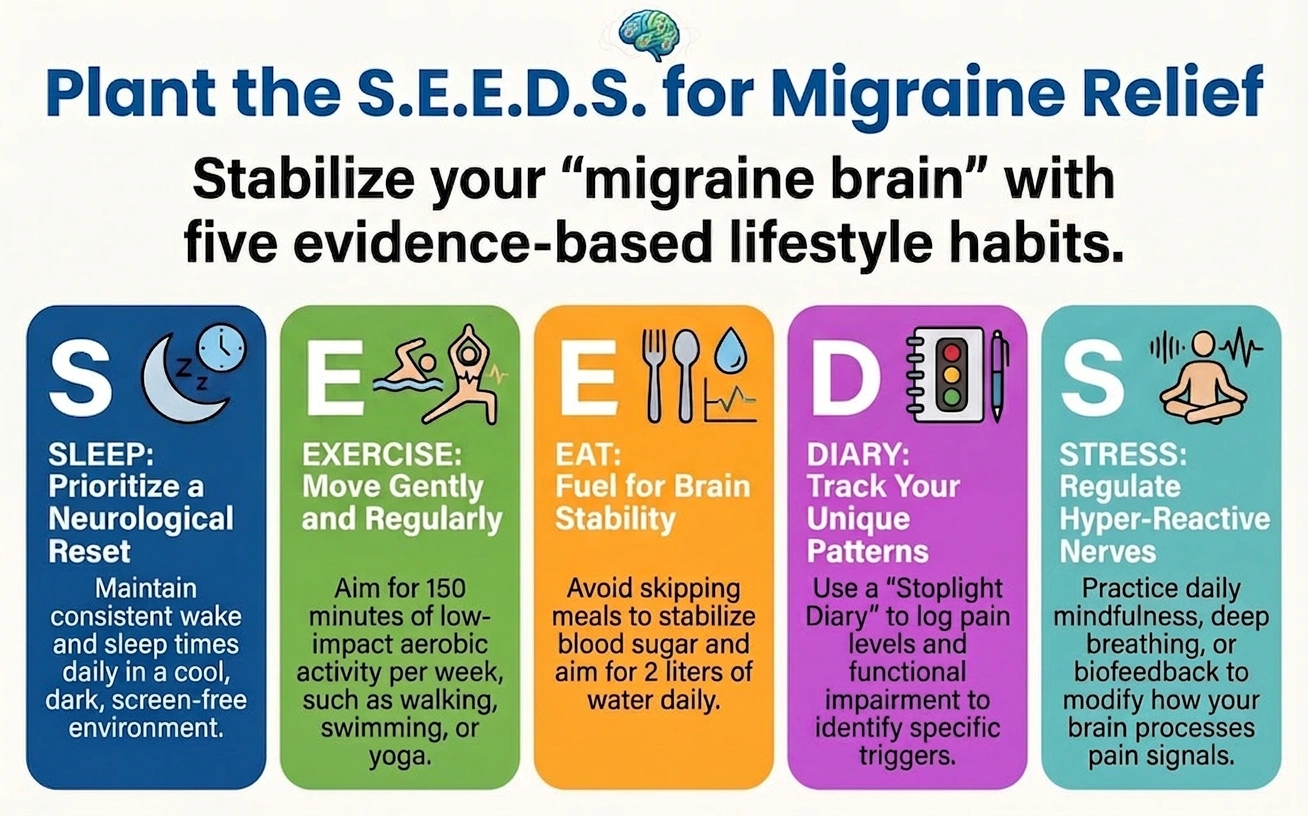
Sleep
Keep a consistent sleep and wake time, even on weekends. Both too little and too much sleep — and irregular timing — are recognized triggers. Keep the bedroom dark, quiet, cool, and screen-free before bed.
Exercise
Aim for about 30–60 minutes of moderate aerobic activity, 3–5 times a week. Walking, swimming, cycling, and gentle yoga are ideal. Ease in gradually — sudden intense exertion can itself spark an attack.
Eat
Don't skip meals or fast — drops in blood sugar are a known trigger. Eat at consistent times, stay well hydrated, and keep caffeine low and steady, since both heavy use and sudden withdrawal can trigger headaches.
Diary
Track each attack: date, suspected trigger, sleep the night before, stress level, and what treatment you used and how well it worked. A diary reveals real patterns and shows whether your plan is working.
Stress
Stress — and often the "let-down" right after a stressful period — is among the most common triggers. Build in daily relaxation, paced breathing, mindfulness, or techniques like biofeedback and CBT proactively, not just during a crisis.
The four phases of a migraine attack
A migraine is a multi-stage neurological event, not just head pain. Recognizing the phases helps you act early — treatment usually works best at the first sign of an attack.
- Prodrome (warning window): Hours to days before pain — yawning, neck stiffness, food cravings, mood changes, fatigue, or trouble concentrating. Acting during this phase can sometimes blunt the attack.
- Aura: Experienced by roughly 1 in 4 patients — visual disturbances (zigzag lines, flashing lights, blind spots), tingling, numbness, or brief language difficulty, usually building over minutes and lasting up to an hour.
- Headache: Typically 4–72 hours of throbbing, often one-sided pain with light, sound, and smell sensitivity, nausea, and cognitive fog. Routine activity tends to make it worse.
- Postdrome ("migraine hangover"): Up to 24–48 hours of fogginess, exhaustion, and body aches. Rest, rehydrate, and ease back in gently to avoid triggering a rebound.
Where supplements fit in
Several nutritional supplements have evidence specifically for migraine prevention — not for stopping an attack already underway. They support the brain's energy metabolism and neuronal stability, and typically take at least three months of consistent use to show measurable benefit.
- Magnesium — the most robustly supported of the group, rated "probably effective" (Level B) by the American Academy of Neurology and American Headache Society. High doses can cause GI upset and interact with some medications, so use it under your physician's guidance.
- Riboflavin (vitamin B2) — also rated "probably effective" (Level B), typically studied at higher daily doses than a standard multivitamin provides.
- Coenzyme Q10 (CoQ10) — smaller, more mixed data; some studies show reduced attack frequency. It can interact with blood thinners like warfarin and isn't recommended in pregnancy.
Before you start
Talk to your physician or pharmacist before beginning any supplement, particularly if you're on other medications or have liver, kidney, or cardiac conditions. Supplements require patience — benefits build gradually over months.
Safety alert: the 10–15 day rule
One of the most frustrating traps in migraine care is that the very medication you rely on for quick relief can make headaches worse if taken too often. This is called medication overuse headache (MOH), or "rebound." To protect against it, headache specialists advise:
| Medication type | Monthly limit |
|---|---|
| Triptans or combination pain relievers (especially those with caffeine or prescription narcotics) | Fewer than 10 days per month |
| Simple analgesics (over-the-counter ibuprofen or acetaminophen) | Fewer than 15 days per month |
If you're regularly exceeding these limits, work with your physician to safely break the rebound cycle and move toward preventive strategies.
Hormonal patterns
Many people notice a connection between their menstrual cycle and migraine frequency or severity. If you see a pattern, track it specifically and discuss it with your physician — it can inform both preventive and acute treatment planning, including for those already on hormonal medications.
When lifestyle changes aren't enough
Lifestyle strategies reduce risk, but they don't eliminate migraine and aren't a substitute for medical treatment if your attacks are frequent, severe, or disabling. Depending on your pattern, your physician may discuss:
- Preventive medications — daily oral therapy, or newer injectable/CGRP options, aimed at reducing attack frequency over time.
- Acute/rescue treatment — an abortive medication taken at the first sign of an attack, which works better than waiting.
- Understanding both together — see our patient guide to acute vs preventive migraine treatment.
- IV migraine cocktail therapy — for a severe flare or status migrainosus that isn't responding to your usual home treatment (cocktail patient guide; see also our migraine infusion therapy overview).
- Step-up infusion options — in select monitored cases, IV lidocaine or ketamine infusion for refractory chronic migraine that hasn't responded to standard treatment.
When to seek emergency care
Lifestyle management is not appropriate for these — get emergency evaluation:
- The "worst headache of your life," especially if it starts suddenly ("thunderclap")
- Headache with fever, stiff neck, confusion, or a new rash
- New neurological symptoms — weakness, numbness, vision loss, or difficulty speaking
- Headache following a head injury
- A new or dramatically different headache pattern after age 50
- Headache that steadily worsens over days and doesn't respond to your usual treatment
Common questions
Will these changes stop my migraines completely?
Not necessarily — migraine is a chronic neurological condition, and lifestyle strategies work by reducing frequency and severity, not by curing it. Most research shows benefit builds over weeks to months of consistency, not overnight.
Do I need to identify every trigger?
No — and trying to avoid everything can become its own source of stress and disability. The bigger-picture goal is a stable routine, not a trigger-free life.
Which supplements actually have evidence?
Magnesium and riboflavin (vitamin B2) are both rated "probably effective" by the AAN and AHS; CoQ10 has smaller, mixed data. Always check with your physician first.
I've tried lifestyle changes and I'm still having frequent attacks. Now what?
That's a good reason to talk to your physician about preventive medication options — and to know that infusion therapy is available for breakthrough attacks that don't respond to your usual home treatment.
Can my rescue medication be causing more headaches?
Yes. Using acute pain relievers too often can cause medication overuse (rebound) headache. Keep triptans/combination relievers under 10 days a month and simple analgesics under 15, and talk to your physician if you're exceeding those limits.
When a severe flare breaks through
Lifestyle strategies are the foundation of migraine care — but when a severe attack breaks through, CarePoint Infusion Center provides physician-directed IV migraine cocktail therapy, with monitoring throughout your visit and a report sent back to your referring provider.
Serving Northeast Ohio Communities
CarePoint Infusion Center supports migraine patients with education and, when needed, IV migraine cocktail therapy throughout Northeast Ohio. We're conveniently located in Beachwood to serve patients from Cleveland and communities across Cuyahoga County. Whether you're searching for migraine help near you in Cleveland, migraine care in Beachwood OH, or headache treatment anywhere in Northeast Ohio, we're here to help.
We conveniently serve patients from:
And throughout Cuyahoga County and Northeast Ohio. Contact us today to learn about migraine care and IV migraine cocktail therapy in Beachwood or Cleveland, Ohio.
Selected references
- Rizzoli P, Mullally WJ. SEEDS for success: Lifestyle management in migraine. Cleveland Clinic Journal of Medicine. 2019;86(11):741-749. ccjm.org
- Robbins MS. Lifestyle Modifications for Migraine Management. Frontiers in Neurology. 2022. Frontiers
- American Migraine Foundation. Lifestyle Changes for Migraine Management. americanmigrainefoundation.org
- American Headache Society. Incorporating Nutraceuticals for Migraine Prevention. americanheadachesociety.org
- National Center for Complementary and Integrative Health. Headaches and Complementary Health Approaches: What the Science Says. NCCIH
- Gaul C, Diener HC, Danesch U. Improvement of migraine symptoms with a proprietary supplement containing riboflavin, magnesium and Q10. J Headache Pain. 2015. PMC4393401
Medical disclaimer: Educational content only. This page describes general lifestyle strategies and is not personalized medical advice. Migraine patterns, triggers, and appropriate treatment vary by individual — talk to your physician or neurologist about a plan tailored to you.